Skip to content







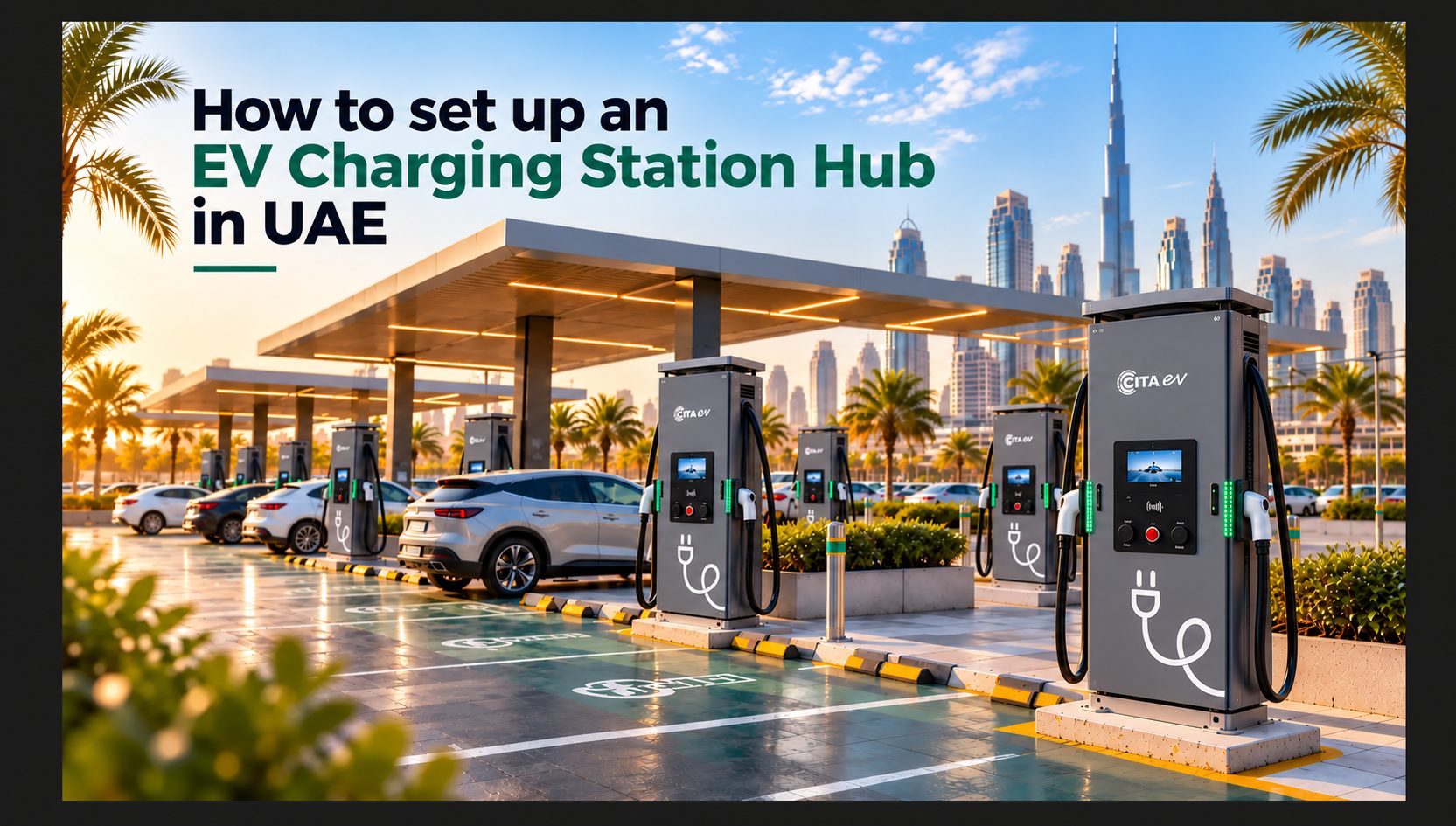
Setting up an EV Charging Station Hub in the UAE is very different from installing one or two standalone chargers. A hub must accommodate multiple EVs, manage significant electrical demand and provide convenient access while remaining scalable as utilisation increases.
The need for this infrastructure is growing. Dubai had 2,223 EV charging points by Q1 2026, while the number of EVs in the emirate reached 47,944 by the end of 2025 – 27.9% higher than a year earlier.
For businesses, CPOs, fleet operators and developers considering a multi-DC-charger facility, understanding how charging hubs work is the first step towards planning one effectively.
What Is an EV Charging Station Hub?
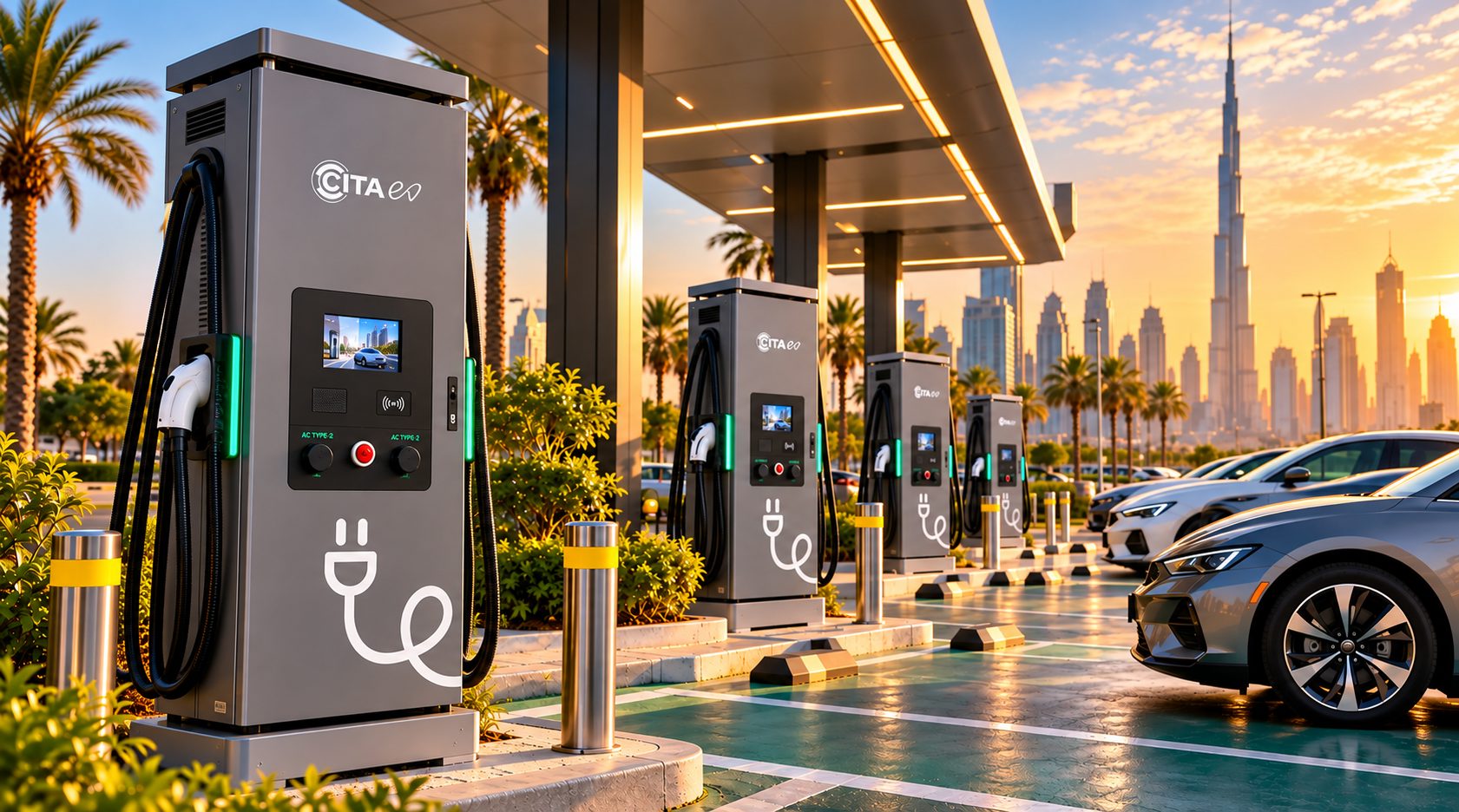
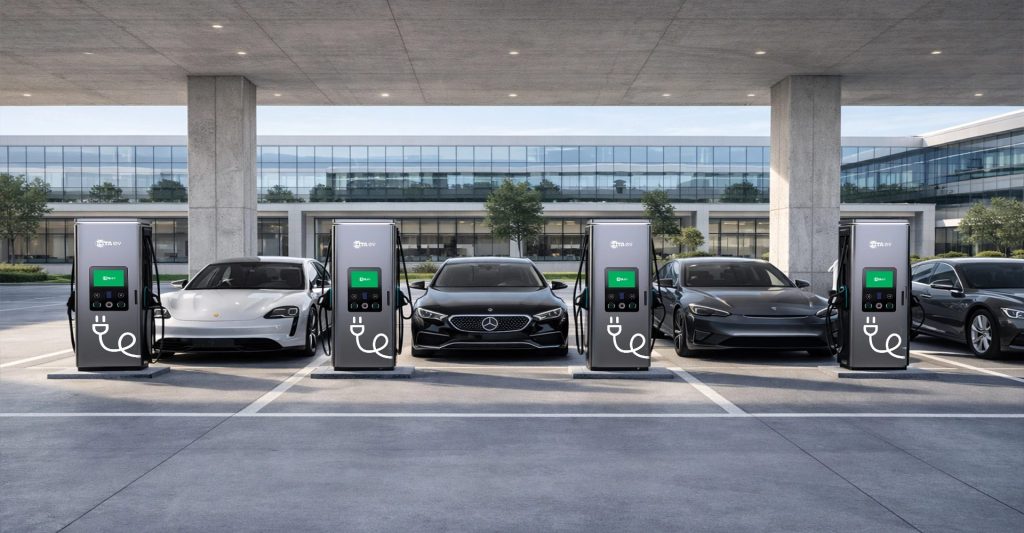
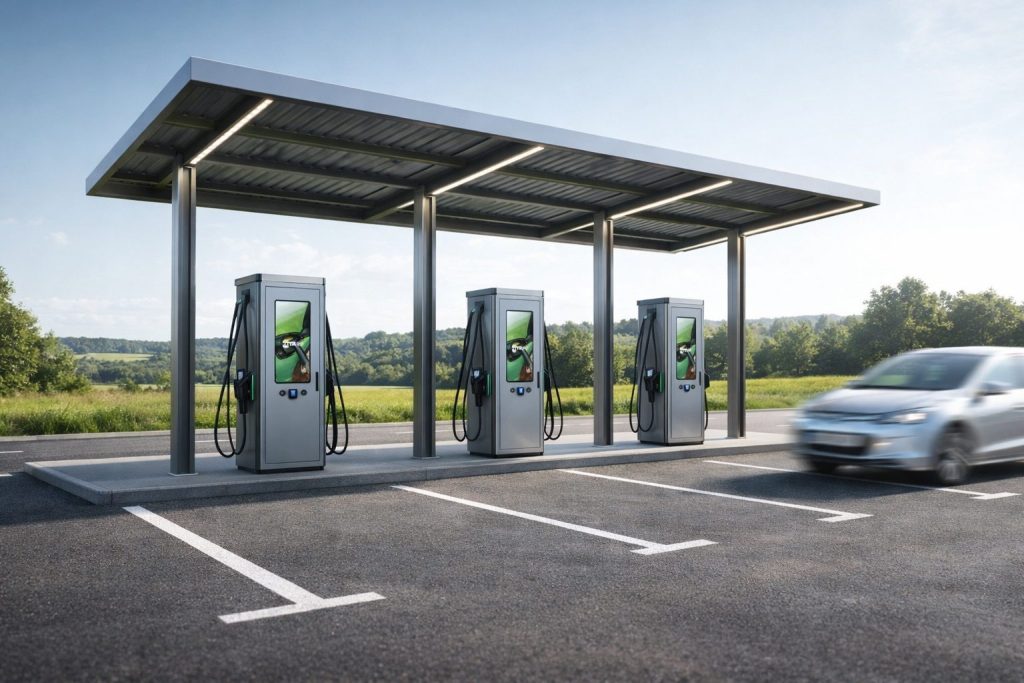
An EV Charging Station Hub is a dedicated location where multiple EV chargers are installed together so several vehicles can charge simultaneously.
Unlike a standalone public charger or home charging point, a hub is designed around higher vehicle volumes. It may include multiple DC fast and ultra-fast chargers, central electrical infrastructure, payment systems, smart load management and a Charge Point Management System (CPMS).
A hub can be thought of as an EV-focused refuelling facility, but its infrastructure works differently from a conventional petrol station. Electricity needs to be distributed intelligently between charging points, and the site’s capacity must be planned around both current and future charging demand.
How Does an EV Charging Station Hub Work?
Every charging hub starts with an electrical connection capable of supplying the site. Power is distributed through the hub’s electrical infrastructure to individual charging units, where it is delivered to connected vehicles.
With multiple DC chargers operating simultaneously, intelligent power management becomes particularly important. Load management systems can distribute available capacity between active charging sessions instead of allowing every charger to demand maximum power at the same time.
A modern hub may also use a CPMS to monitor charger status, sessions, payments, electricity consumption and faults remotely.
Some larger developments may incorporate battery energy storage or solar canopies. Battery storage can potentially supplement grid supply during periods of high demand, while solar can contribute renewable electricity and provide valuable shade in the UAE climate.
What Types of EV Charging Hubs Are There?
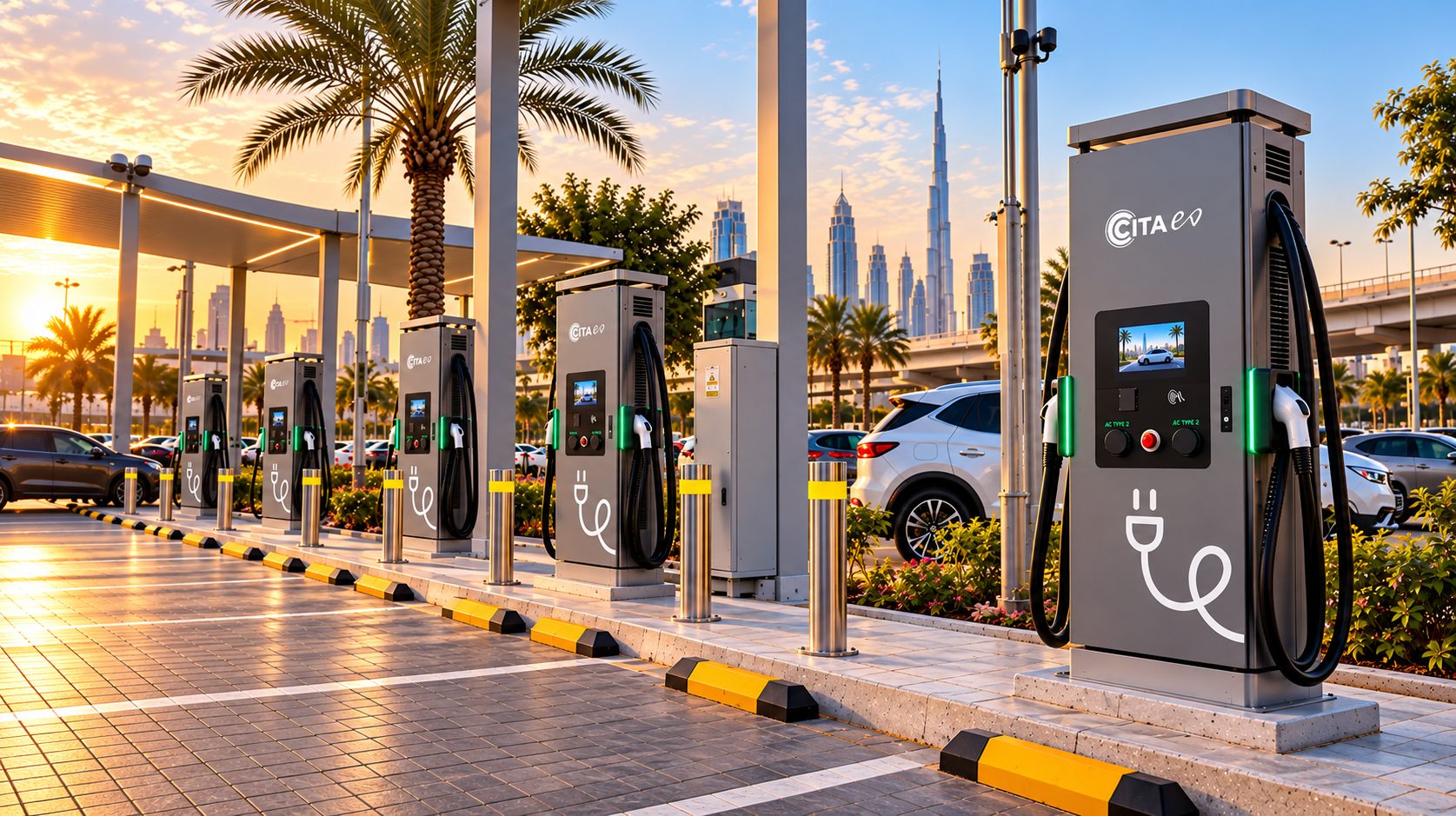
Not every EV Charging Station Hub serves the same type of driver. Its design, charger power and location should reflect its primary use case.
1) Public Fast-Charging Hubs
These facilities serve general EV drivers and typically use multiple DC fast or ultra-fast chargers. They can be located near busy roads, commercial areas and other easily accessible locations where drivers need relatively quick charging.
2) Highway Charging Hubs
Located near major roads and inter-emirate routes, highway hubs prioritise fast vehicle turnaround. Higher-power DC chargers are particularly relevant because drivers generally want to add significant range before continuing their journey.
3) Fleet and Taxi Charging Hubs
Fleet hubs are designed around high vehicle utilisation. Taxis, delivery vehicles and commercial fleets may return repeatedly throughout the day, making charger availability, turnaround time, scheduling and load management especially important.
4) Commercial and Destination Hubs
Shopping centres, hotels, business districts and large car parks can also incorporate multi-charger facilities. Charging power can be selected according to how long vehicles typically remain at the location and the expected level of demand.
Where Are EV Charging Hubs Best Located in the UAE?
A successful charging hub needs both vehicle demand and sufficient electrical infrastructure. High traffic alone does not automatically make a location suitable.
Potential locations include:
- Major highways and inter-emirate routes
- Airports and transport hubs
- Shopping malls and retail destinations
- High-density residential communities
- Business and commercial districts
- Taxi and ride-hailing operating areas
- Logistics and fleet depots
- Large public and private car parks
Accessibility matters as much as visibility. Drivers should be able to enter, locate an available charger, manoeuvre into the charging bay and exit without unnecessary congestion.
Grid capacity should also be investigated before committing to a site. A highly visible location may prove commercially difficult if supplying several high-power DC chargers requires extensive electrical upgrades.
Why Are EV Charging Hubs Important?
Charging hubs can provide significantly more capacity than isolated chargers because several vehicles can charge at the same location simultaneously.
For drivers, this can improve charger availability and reduce dependence on a single charging point. For fleets, multiple chargers can help keep more vehicles operational while reducing charging bottlenecks.
Hubs are also scalable. A well-designed site can begin with a smaller number of chargers and expand as demand increases, provided electrical infrastructure, conduits, switchgear and physical space have been planned accordingly.
For the UAE, this model can support public charging, long-distance travel, commercial fleets and drivers without convenient access to private charging.
EV Charging Hub vs Home Charging
Home charging and public charging hubs serve different purposes and should complement rather than replace one another.
| Factor | EV Charging Station Hub | Home Charging |
|---|---|---|
| Primary purpose | Public, fleet or high-demand charging | Everyday personal charging |
| Number of vehicles | Multiple EVs simultaneously | Usually one or two |
| Typical charger | Mainly DC fast/ultra-fast at dedicated hubs | Primarily AC |
| Charging priority | Faster turnaround | Convenient overnight charging |
| Electrical requirement | High commercial/grid capacity | Residential supply |
| Payment system | Usually required for public use | Generally not required |
| Smart management | Multi-charger CPMS/load management | Individual smart charging |
| Best suited for | Journeys, fleets, taxis and public charging | Regular daily charging |
The difference is therefore not simply faster versus slower charging. A hub is infrastructure designed to manage multiple vehicles and significant energy demand, whereas home charging is primarily built around convenient charging for an individual household.
How to Set Up an EV Charging Station Hub in the UAE
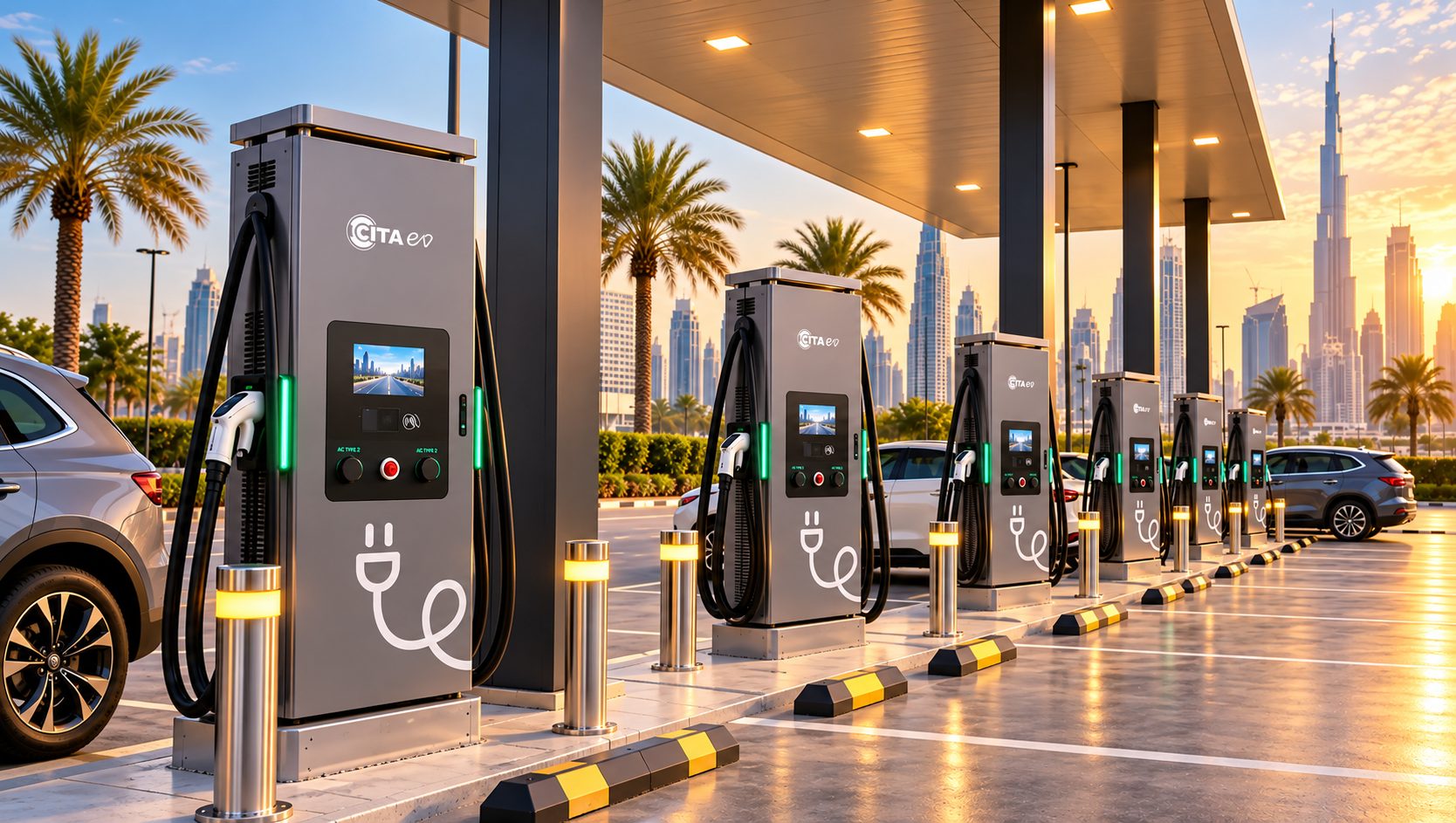
Once the purpose, type and operating model of the hub are clear, planning can move to the practical stage. The key questions are: Where should the hub be located? How many chargers are needed? How much space and electrical capacity will be required?
These decisions should be considered together because each directly affects the design, investment and future scalability of the facility.
1) Choose the Right Location and Assess Demand
Start by understanding who will use the hub and how frequently. Locations near highways, airports, commercial districts, residential communities, shopping destinations and fleet routes may offer strong potential, but traffic alone is not enough.
Analyse expected EV volumes, nearby charging competition, accessibility, visibility and average dwell time. A good hub location should combine consistent charging demand with convenient vehicle access and sufficient potential for future growth.
2) Determine the Number of Chargers and Space Required
There is no fixed number of chargers or square-foot requirement for an EV Charging Station Hub. A smaller commercial facility may begin with 4–6 DC charging positions, while high-demand fleet or highway hubs may require considerably more.
As an early planning estimate, 4–6 bays might require roughly 3,000–5,000 sq. ft., depending on electrical equipment, circulation, queues, accessibility and amenities. Final dimensions should always follow professional site design.
3) Assess Grid Capacity and Select the Right DC Chargers
Grid availability should be evaluated before finalising the site or charger configuration. For perspective, six 180kW chargers represent 1.08MW of theoretical connected charging capacity.
Operators should assess transformers, switchgear, connection capacity and future electrical demand while selecting charger power according to expected vehicles and turnaround requirements. Highway, taxi and fleet hubs may benefit from higher-power DC charging, while other locations may require a different power mix.
4) Plan Vehicle Flow, Load Management and User Experience
A successful hub should allow drivers to enter, find a charger, park, connect and leave without creating unnecessary congestion. Site design should account for queues, turning space, cable reach, accessibility, signage and different EV charging-port positions.
Smart load management can distribute available electricity between active chargers, while a CPMS can support remote monitoring, payments, charger status, energy consumption and fault management across the complete facility.
5) Design for UAE Conditions and Regulatory Requirements
UAE heat, dust and prolonged outdoor exposure make environmental protection and thermal management important charger-selection criteria. Equipment should be evaluated for operating temperature, enclosure protection, cooling architecture and long-term outdoor suitability. Regulatory requirements must also be addressed early.
In Dubai, relevant DEWA approvals and CPO requirements may apply, while Abu Dhabi follows its own regulatory framework. Requirements should therefore be confirmed specifically for the emirate where the hub will operate.
6) Build Scalability into the Initial Design
An EV charging hub should be designed around both current and future demand. Instead of installing excessive capacity immediately, operators can consider phased expansion while preparing spare conduits, electrical capacity, switchgear, charger foundations and additional parking space from the beginning.
Battery storage and solar canopies may also be evaluated where commercially and technically appropriate. Planning for expansion early can make adding chargers considerably easier as utilisation and EV adoption increase.
Challenges to Consider Before Developing an EV Charging Hub
Developing an EV Charging Station Hub requires careful feasibility planning. Some of the key challenges include:
- Grid Capacity: High-power DC chargers can create significant electrical demand, and some locations may require grid or transformer upgrades.
- Land and Construction Costs: Suitable land, civil works and electrical infrastructure can increase initial project costs, particularly in premium locations.
- Charger Utilisation: Low utilisation during the early stages can extend the investment payback period and affect overall project economics.
- Vehicle Queuing: If charging demand exceeds available capacity, queues can develop during peak periods and affect the user experience.
- Heat and Environmental Conditions: UAE temperatures, dust and prolonged outdoor exposure make effective cooling, equipment protection and durability important considerations.
- Future Expansion: The site should have sufficient electrical and physical capacity to accommodate additional chargers as EV demand increases.
Evaluating these challenges before purchasing hardware can help ensure that land, electrical capacity, charger configuration and expected demand work together effectively.
How EV Charging Hubs Support the UAE's Electric Future
As EV adoption increases, charging infrastructure must expand beyond individual chargers towards locations capable of serving multiple vehicles efficiently.
Charging hubs can support drivers travelling between emirates, provide infrastructure for people without private charging, and enable taxi, delivery and commercial fleets to electrify at scale.
They can also become smarter energy assets. Load management, renewable generation, battery storage and connected charger management can help future hubs use electricity more intelligently.
The development of large-scale charging facilities in Dubai already demonstrates how the model can support high-utilisation vehicle segments. As demand grows across the UAE, scalable charging hubs can become an increasingly important link between the electricity network and electric transport.
Build Your EV Charging Station Hub with CITA EV Charger
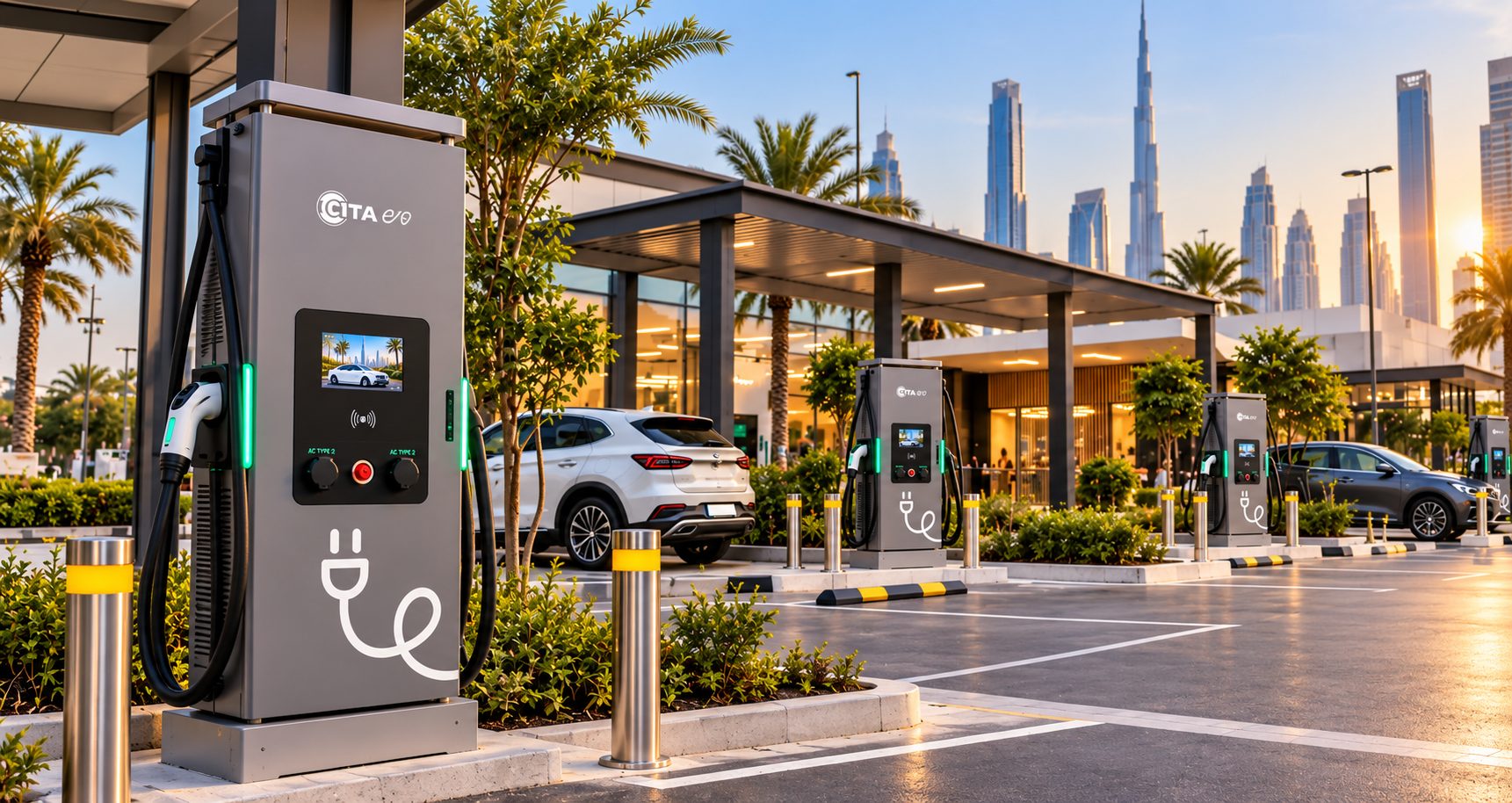
A successful EV Charging Station Hub starts with the right planning – not simply the largest number of chargers. Location, demand, grid capacity, charger configuration, vehicle flow, software, climate protection and future scalability all need to be considered together.
CITA EV Charger provides DC fast and ultra-fast charging solutions up to 480 kW, alongside scalable split DC charging systems designed for larger multi-vehicle charging applications. Combined with smart charge point management and load-management capabilities, these solutions can support public charging hubs, commercial developments, fleets and other high-utilisation environments.
Whether you are considering four DC charging positions or planning a much larger charging facility, selecting infrastructure around the site’s actual requirements creates a stronger foundation for long-term operation.
Planning an EV Charging Station Hub in the UAE?
Contact CITA EV Charger today for a free consultation and discuss the right charging configuration for your project.
There is no fixed number of chargers required for a Charging Station Hub. The right number depends on expected EV traffic, charger utilisation, available grid capacity and average charging duration. A smaller commercial hub may start with 4–6 DC charging positions, while busy fleet or highway hubs may require considerably more.
Space requirements depend on the number of charging bays, charger configuration, electrical equipment, vehicle circulation and amenities. As an early planning estimate, a 4–6 bay DC hub may require around 3,000–5,000 sq. ft., although the final footprint should always be determined through professional site design and applicable local requirements.
An Electric Vehicle Charging Station Hub should ideally be located where there is consistent EV traffic, convenient road access and sufficient electrical capacity. Locations near highways, commercial districts, residential communities, airports, shopping destinations, taxi routes and fleet operations may offer strong potential depending on local charging demand and existing competition.
Consider expected vehicle types, maximum EV charging capabilities, average dwell time, daily charging demand and available grid capacity. High-utilisation taxi, fleet and highway locations may require higher-power DC chargers, while other commercial hubs may benefit from a mix of charging capacities combined with smart load management.
Yes, applicable approvals depend on the emirate and project type. In Dubai, DEWA regulates EV charging infrastructure, and approval is required before establishing, installing, operating or maintaining EV charging stations. Businesses planning public charging services should also determine whether relevant Charge Point Operator (CPO) requirements apply to their project.