Skip to content







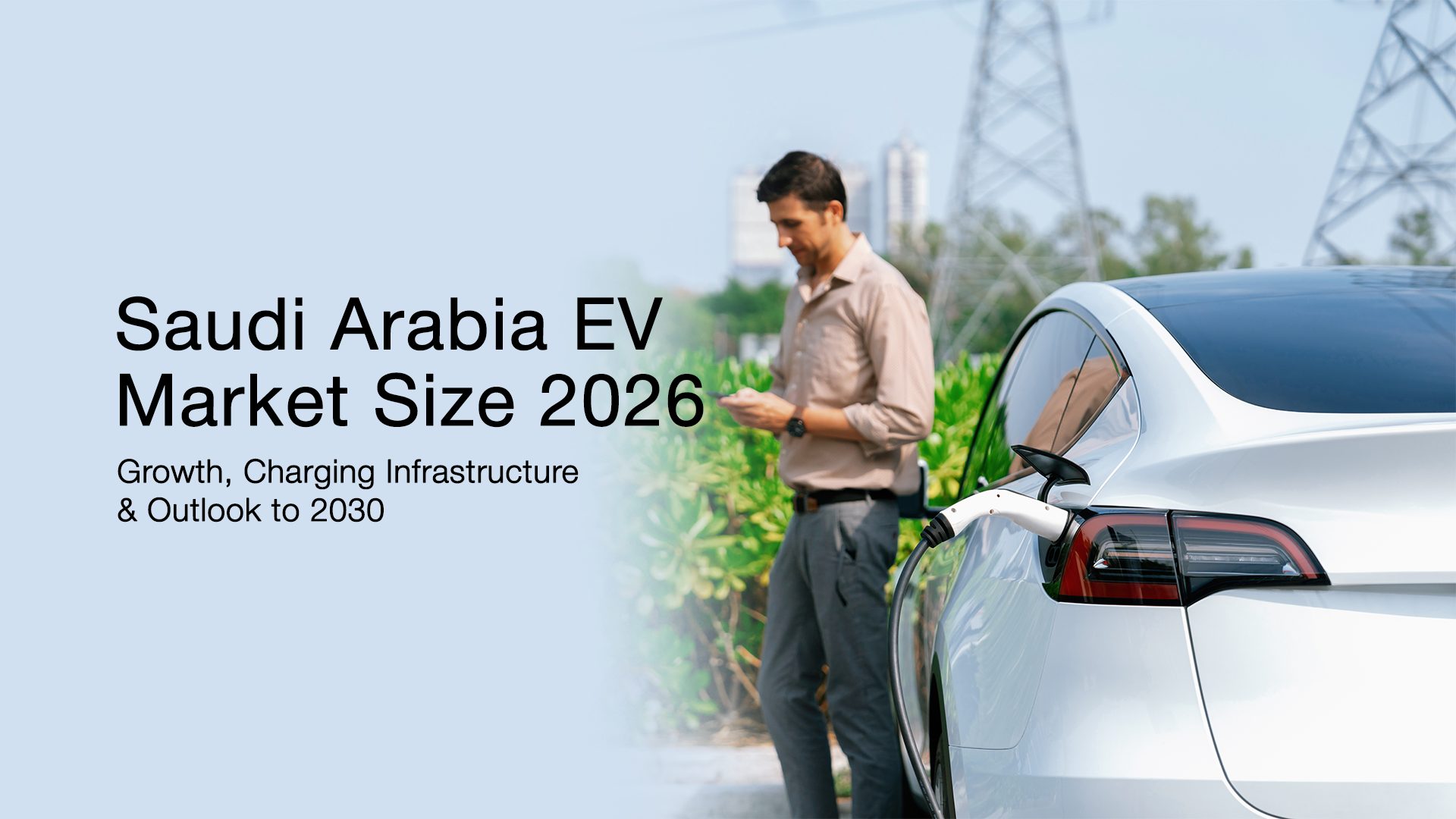
The Saudi Arabia EV Market Size 2026 reflects one of the fastest-evolving electric mobility markets in the Middle East. Saudi Arabia, long defined by its oil economy, is now becoming one of the region’s most closely watched EV markets.
The shift is being driven less by organic consumer demand and more by deliberate state policy: Vision 2030 electrification targets, Public Investment Fund (PIF) capital, expanding EV charging infrastructure in Saudi Arabia, and manufacturing deals designed to turn the Kingdom into a regional EV production hub rather than simply a buyer of imported electric vehicles.
Key Takeaways
- Estimates for the Saudi Arabia EV Market Size 2026 vary by research firm, from roughly $1.8 billion to $5.8 billion for 2025-2026, depending on scope and methodology. All figures point the same direction: strong double-digit annual growth through 2030.
- The Kingdom had 2,803 public charging points as of early 2026, with a government-backed push toward 5,000 fast chargers and 30,000 total charging points by 2030.
- Vision 2030 targets 30% of vehicles in Riyadh running on electric power, backed by a 10-year Saudi government commitment to purchase up to 100,000 Lucid vehicles.
- Local manufacturing is scaling fast: Lucid’s AMP-2 plant, the PIF-Foxconn CEER joint venture, and a new Hyundai-PIF assembly plant are all ramping production for the domestic and export markets.
How Big Is Saudi Arabia's EV Market in 2026?

There isn’t one universally agreed figure for the Saudi Arabia EV Market Size 2026, and that’s worth explaining rather than glossing over. Different research firms define the Saudi Arabia electric vehicle market differently – some measure vehicle sales alone, while others incorporate infrastructure, services, and related segments.
What these reports agree on, regardless of methodology, is the direction and pace: Saudi Arabia’s EV market is compounding at somewhere between 13% and 33% annually, among the fastest growth rates in the GCC. Passenger vehicles dominate, accounting for roughly 75-78% of unit sales, with Tesla, Lucid, and BMW together capturing the largest share of new registrations.
If you’re citing a market-size figure for Saudi Arabia, always name the research firm and the scope of “market” they’re measuring. Presenting a single number as a consensus fact when five firms disagree by an order of magnitude is a common and avoidable credibility problem in EV market content.
Saudi Arabia EV Market Analysis (2023-2030)
EV Charging Infrastructure in Saudi Arabia

Charging availability is the practical constraint on adoption, and it’s expanding fast:
- Current network: 2,803 public charging points as of early 2026, up from around 1,000 in early 2024 and just 150 in 2022.
- EVIQ rollout: EVIQ, a joint venture between PIF and the Saudi Electricity Company, is deploying over 5,000 fast chargers and more than 1,000 charging hubs nationally, including 60 new stations completed across key cities in 2025 and the first intercity highway station on the Riyadh-Qassim route.
- 2030 target: the government’s stated goal is 30,000 new charging stations nationwide by 2030, supporting the Vision 2030 target of 30% of Riyadh’s vehicles running on electric power.
- Private-sector partnerships: ABB and Electromin have deployed public charging networks across roughly 100 locations, and EVIQ has signed municipal agreements (including with Remat Al-Riyadh) to localise deployment in high-density areas.
For a home or business owner deciding whether to install a charger now, the infrastructure trend line matters more than any single snapshot number: station count has grown nearly 20x since 2022, and public investment is accelerating rather than slowing down.
Vision 2030 Policy and Incentives Driving Adoption

Saudi Arabia’s EV growth is policy-led in a way that’s unusual even by GCC standards. Vision 2030 EV targets, government investment, fleet electrification and incentives are creating the conditions for continued expansion of the EV market in Saudi Arabia. Key mechanisms include:
- Vehicle purchase commitment: a 10-year government commitment to buy up to 100,000 vehicles from Lucid Motors, guaranteeing demand for a locally manufactured EV.
- Fleet electrification quotas: mandatory EV adoption targets for government and ride-hailing fleets, which pull commercial-vehicle electrification ahead of consumer demand.
- Consumer incentives: customs duty exemptions, reduced home-charging electricity rates, and free parking in designated zones.
- Environmental mandate: the Saudi Green Initiative’s target to cut carbon emissions by more than 278 million tonnes annually by 2030, which ties EV adoption directly to national climate commitments rather than treating it as optional.
Saudi Arabia EV Industry Development (2023-2030)
Analysis of Recent Developments and Future Planning in the Kingdom's Electric Vehicle Sector
Manufacturing: Saudi Arabia's Push to Become a Regional EV Hub
The Kingdom isn’t just buying EVs – it’s building them. Saudi Arabia EV manufacturing has become an important pillar of the country’s wider electric mobility strategy and a major factor shaping the long-term Saudi Arabia EV Market Size 2026 outlook.
- Lucid Motors operates its first international manufacturing facility (AMP-2) in Saudi Arabia and raised roughly $1.05 billion in April 2026 to accelerate production, backed by PIF and Uber investment.
- CEER, the PIF-Foxconn joint venture, has signed roughly SAR 5.5 billion in local supply agreements (80% with Saudi firms) to localise battery and component production ahead of its vehicle launch.
- Hyundai, in partnership with PIF, broke ground on a $500 million assembly plant targeting 50,000 vehicles annually, with production starting in 2026.
Collectively, these projects support the Kingdom’s stated ambition of 500,000 units of annual domestic EV production capacity by 2030, a shift from EV importer to regional manufacturing and export hub.
Consumer Adoption: What's Changing on the Ground
CITA EV Chargers
Leading EV Charger Manufacturer in Saudi Arabia
Ready to Power Your Electric Future?
Transform your property into a charging destination with CITA's advanced EV charging solutions.
Contact Our Experts TodayA few concrete signals of shifting consumer sentiment:
- EV registrations grew significantly between 2020 and 2023, according to Saudi Arabian Monetary Authority (SAMA) data.
- New, lower-priced models are reaching the market: Tesla launched the Model 3 Standard in Saudi Arabia in January 2026 at SAR 154,990, with deliveries starting mid-2026, and GAC Motors debuted its Aion and Hyptec EV lines at the Riyadh Motor Show in December 2025.
- Passenger EVs remain the dominant segment (roughly three-quarters of sales), but commercial and fleet electrification is growing at a faster rate, driven by government mandates and total-cost-of-ownership advantages for logistics and ride-hailing operators.
Market Outlook to 2030
The Saudi Arabia EV Market Size 2026 provides a useful baseline for understanding where the market could be heading by 2030. Every major research estimate points to continued acceleration through the back half of the decade, driven by three compounding factors: an expanding charging network reducing range anxiety, growing local manufacturing capacity cutting vehicle costs and delivery times, and Vision 2030 policy mandates that don’t rely on organic consumer demand alone.
The specific dollar figure a given report lands on depends heavily on scope, but the underlying trend, rapid, policy-backed growth from a small base, is consistent across every source we reviewed.
Powering the Charging Side of Saudi Arabia's EV Growth
Sources:
IMARC Group, MarkNtel Advisors, PS Market Research, Mordor Intelligence, Knowledge Sourcing, Mobility Foresights, Ken Research, Saudi Mobility Consulting, Arab News, Vision2030.gov.sa, and Saudi Arabian Monetary Authority (SAMA). Retrieved August 2026.
Frequently asked questions
The Saudi Arabia EV Market Size 2026 is estimated at roughly $1.8 billion to $5.8 billion, depending on the research firm and market scope. Despite differences in methodology, major reports point toward continued double-digit annual growth through 2030, supported by rising EV adoption, government investment, local manufacturing and expanding charging infrastructure.
Saudi Arabia had approximately 2,803 public EV charging points as of early 2026. The Kingdom is rapidly expanding its charging network, with a government target of 30,000 charging stations nationwide. EVIQ also plans to deploy more than 5,000 fast chargers across strategic locations by 2030, improving charging accessibility for both private and commercial EV users.
As part of Vision 2030, Saudi Arabia aims for electric vehicles to account for 30% of vehicles in Riyadh by 2030. This ambition is supported by wider electrification initiatives, investment in EV manufacturing and charging infrastructure, fleet adoption, and the government’s 10-year commitment to purchase up to 100,000 Lucid electric vehicles. Together, these initiatives are designed to accelerate EV adoption while supporting the Kingdom’s broader sustainability and economic diversification goals.
Saudi Arabia’s EV manufacturing sector is led by Lucid Motors, Ceer, and Hyundai. These major PIF-backed investments are expanding local EV production, strengthening domestic automotive manufacturing, creating new industry capabilities, and supporting the Kingdom’s broader Vision 2030 goals.
Sources:
IMARC Group, MarkNtel Advisors, PS Market Research, Mordor Intelligence, Knowledge Sourcing, Mobility Foresights, Ken Research, Saudi Mobility Consulting, Arab News, Vision2030.gov.sa, and Saudi Arabian Monetary Authority (SAMA). Retrieved August 2026.