Skip to content







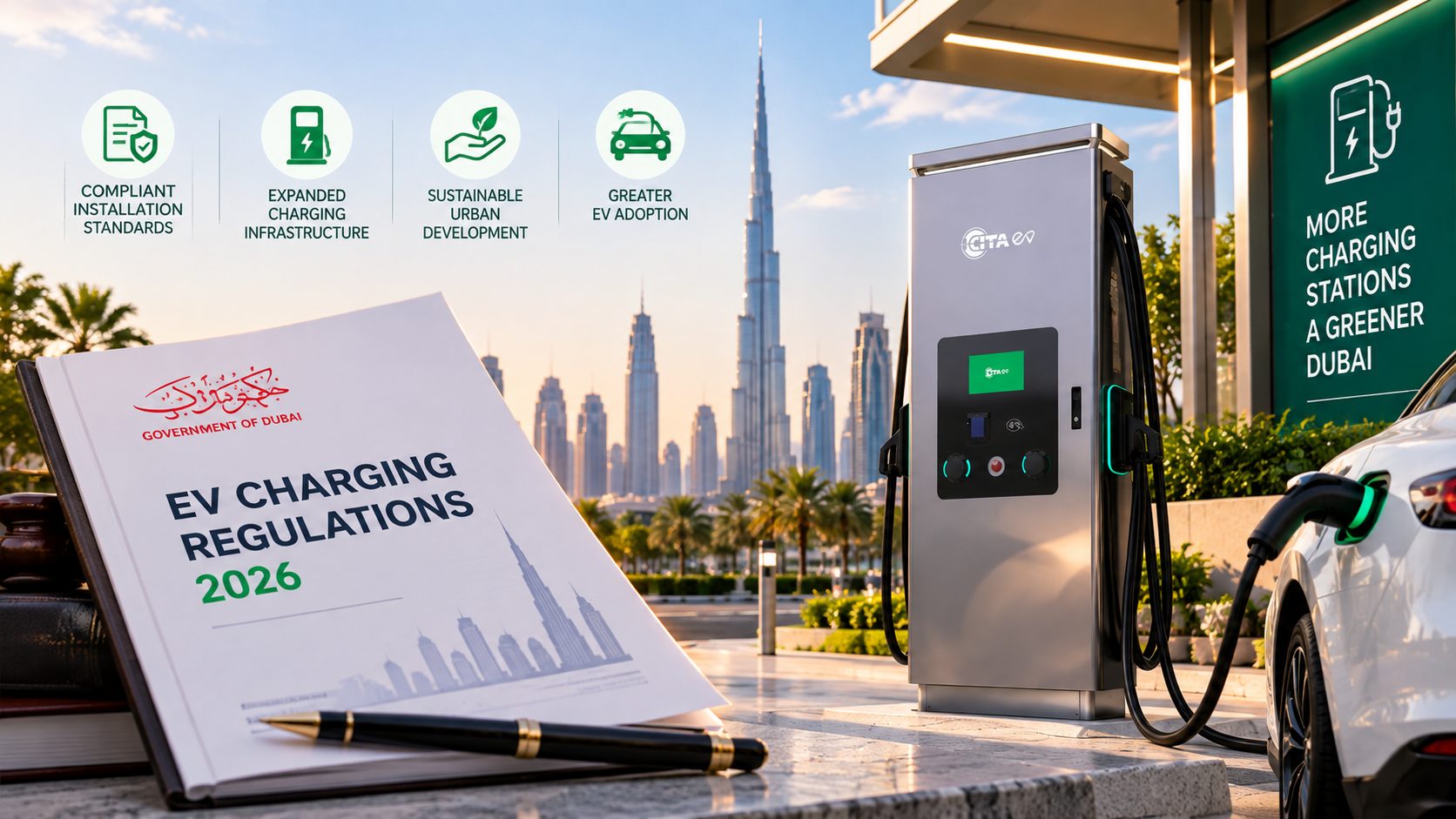
Dubai’s EV Charging Regulations are playing an increasingly important role as the emirate expands its charging network and prepares infrastructure for a rapidly growing number of electric vehicles.
Under Dubai Electricity and Water Authority’s (DEWA) regulatory framework, companies or individuals operating public EV charging equipment must obtain a Charge Point Operator (CPO) licence and comply with applicable EV charging regulations. The transitional compliance period for existing public charging operators ended on 31 March 2025, making the licensing framework fully applicable to operators today.
DEWA provides separate licensing routes for operators offering free charging and those collecting payments from EV users. Private charging installations are also regulated and must follow applicable procedures to obtain DEWA approval and comply with EV Charging Technical Regulations.
The framework comes as Dubai’s charging ecosystem continues to expand. DEWA reported that the emirate reached 2,223 EV charging points by the first quarter of 2026, while the number of EVs reached 47,944 by the end of 2025, representing 27.9% year-on-year growth.
Supporting Compliant EV Charging Infrastructure
For businesses, property developers and charging operators, the evolving EV Charging Regulations highlight the importance of considering approvals, technical requirements and infrastructure planning before installing EV chargers.
CITA EV Charger provides AC and DC EV charging solutions from 7kW to 480kW for residential, commercial, fleet and public charging applications across the UAE.
Planning an EV charging project in the UAE?
Contact CITA EV Charger to discuss a charging solution suited to your site and operational requirements.