Skip to content







The UAE has officially entered a new chapter in its electric mobility journey.
As of 2025, the country has moved away from free public EV charging to a standardised, paid model – marking a strategic shift toward scaling up sustainable infrastructure and preparing for long-term EV adoption.
In Abu Dhabi, the Integrated Transport Centre (Abu Dhabi Mobility), under the Department of Municipalities and Transport, announced a major rollout of 1,000 new electric vehicle (EV) charging stations across 400 locations in the Emirate.
These stations will operate under a unified brand called Charge AD, with consistent tariffs across the board: AED 0.70/kWh for AC charging and AED 1.20/kWh for fast DC charging. This marks the first time a universal pricing structure has been introduced, ending years of free or variable-cost public charging across the Emirates.
What’s Driving the Change?

In short: scalability, investment, and climate goals.
Abu Dhabi Mobility’s approach uses public-private partnership (PPP) contracts, where select operators will handle the supply, installation, operation, and maintenance of the charging points. This PPP model opens doors for efficient expansion, better service management, and more innovation across the network. The first phase covers key regions including Abu Dhabi Island, Al Ain, and Al Dhafra, with an annual plan to increase the number of stations in response to growing demand.
This move aligns with the UAE’s wider sustainability goals, including its Net Zero 2050 vision and Abu Dhabi’s target for 50% of vehicles to be electric by 2040. And the numbers show the transition is gaining speed—over 15,000 EVs were registered in Abu Dhabi in Q1 of 2025 alone, a 60% rise compared to the same period last year.
Similar growth trends are being observed in Dubai, where the number of public chargers recently crossed 700, with a goal of hitting 1,000 stations by 2025.
CITA EV Chargers: Supporting the Transition with Smart Charging Solutions
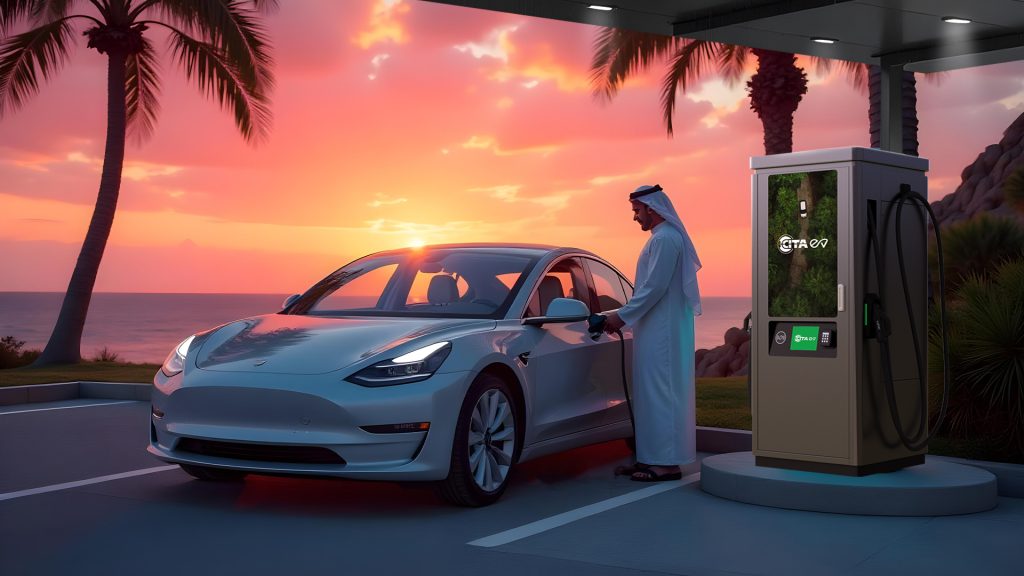
As the UAE moves into the paid-charging era, the demand for high-performance, reliable charging hardware has never been greater. That’s where CITA EV Chargers come in. Offering both AC chargers (7kW, 22kW and Dual 44kW) and DC fast chargers (60 kW to 360 kW), CITA’s portfolio is built for everything from homes to commercial parking lots to public EV charging stations.
Backed by certifications like DEWA and ADQCC, and equipped with features like the CITA EV App and Charger Point Management System, these EV chargers are ready to support the UAE’s electric future with speed, safety, and scalability.
Looking to future-proof your EV infrastructure?
Get in touch with CITA EV Charger to explore our full range of AC and DC solutions.